

All Roofs Leak Eventually

Don’t wait for damage to dictate your next move. Get a professional roof assessment now and discover if your system can be saved—not replaced. Our high-resolution thermal imaging reveals hidden moisture and helps determine Roof Sentry compatibility.
Got a wet roof? You don’t need a tear-off, you need Roof Sentry
Act early, save thousands.
Schedule your consultation today.

Why Infrared Roof Inspections
Infrared roof inspections have been in use since the early to mid-1970s, originally tested in part by the U.S. Army Corps of Engineers in collaboration with the Cold Regions Research & Engineering Laboratory (CRREL). Over the decades, this technology has advanced dramatically. Modern infrared cameras now use ultra-sensitive, high-resolution sensors capable of detecting extremely small temperature variations.
These subtle differences, often just a few degrees Fahrenheit, reveal areas where roof insulation is wet versus dry. Because wet insulation retains heat differently than dry insulation, thermal imaging can map moisture intrusion across an entire roof surface without invasive testing. This precise, non-destructive method allows for faster, more accurate roof assessments than ever before.


Wet insulation absorbs more heat during the day

And releases more stored heat during the evening
Visual vs. Infrared
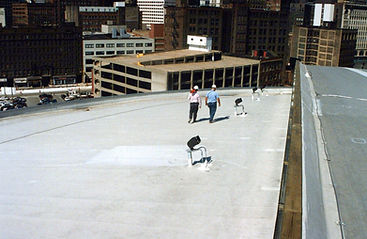
A visual roof inspection is an important first step in assessing the overall condition of a roof surface, as well as rooftop equipment and penetrations. This type of survey is typically used to identify obvious defects in the membrane or flashing, especially at locations where leaks are already known or suspected.
As part of a standard roof maintenance program, visual inspections should be conducted up to twice a year. These visits help identify visible signs of damage, ensure drains and gutters remain clear, and provide insight into the roof’s approximate age and remaining service life. When performed thoroughly, visual surveys can be a valuable tool for roof asset managers.
However, visual inspections have clear limitations—particularly on large roofs or buildings with multiple roof sections. Pinpointing the source of a leak can be like “looking for a needle in a haystack.” Many conditions that allow water to enter a building envelope are subtle and not easily detected with the naked eye. In some cases, inspectors may walk directly over a problem area without realizing it, especially if the leak hasn’t yet appeared inside the building. The contractor could be looking for a leak in the entirely wrong area of the roof (or not at all)!

Making the Invisible - Visible


Infrared roof inspections are one of the most effective ways to locate leaks and identify moisture-damaged insulation and building components quickly and accurately. As the saying goes, “a picture is worth a thousand words”, and infrared imaging delivers exactly that, providing visual proof of problem areas that other inspection methods can only guess at.
With an infrared moisture survey, you can not only pinpoint the exact location of leaks, but also gauge the extent of the damage to the insulation system and surrounding building materials. When performed by a skilled technician, today’s high-sensitivity infrared cameras can even distinguish between “wet” and “damp” insulation, giving you a clearer picture of your roof’s condition.
Another advantage is efficiency. Infrared inspections dramatically reduce the time needed to assess a roof and eliminate much of the speculation that can slow down traditional methods. The result: faster, more accurate decisions and targeted repairs that save time, money, and unnecessary effort.
With 40 years of inspection expertise, we know what works - and nothing finds hidden roof problems faster or more accurately than Infrared (Thermal) Imaging.
Before you spend a dime on roof work, get the facts. Infrared inspections reveal the hidden truth about your roof - pinpointing exactly where moisture is trapped beneath the surface before it causes major damage. But detection is only the first step. Once you know where the problem is, you need a way to remove the moisture and stop further deterioration.
That’s where the Roof Sentry System comes in. Using patented technology, Roof Sentry actively draws trapped moisture out of your insulation and roof assembly, drying it from the inside out. By combining precision infrared detection with targeted moisture removal, you not only halt existing damage but also prevent future issues - extending your roof’s service life by years.
This often saves building owners hundreds of thousands in avoided tear-offs and repairs. With infrared data guiding installation, every system is placed exactly where it will have the greatest impact. Whether you manage one building or an entire portfolio, pairing infrared scans with the Roof Sentry System is the smartest way to protect your assets, reduce costs, and plan with confidence.
As Wayne Tobiasson of the U.S. Army Corps of Engineers – CRREL put it:
“It is fiscally irresponsible to undertake any roofing project without first conducting a roof moisture survey.”
We take that a step further—we believe that it’s equally unwise to move forward without first considering whether the Roof Sentry System could save you hundreds of thousands of dollars in avoided repairs, tear-offs, and premature replacements. Skipping that step isn’t just risky—it’s a costly missed opportunity.
Conclusion:


